Why the Right Pipe Supplier Actually Matters
Picture this: you’re midway through a large-scale industrial project, timelines are tight, and your pipe stock runs short. You scramble for a quick replacement — only to receive material that’s off-spec, inconsistently finished, or poorly toleranced. Production halts. Costs spike. And the blame game begins.
It’s a scenario that plays out more often than you’d think in industries that rely on structural and mechanical tubing. The truth is, the quality of your pipes is only as good as the supplier behind them.
If you’re searching for a reliable CRC Round Pipes Supplier or a trusted CRC Oval Pipes Supplier, this article is written for you — whether you’re a procurement head, a project engineer, or a business owner making your first bulk steel purchase. We’ll walk you through what CRC pipes are, why they matter, how to choose the right supplier, and what sets Vardhman Steel Tubes apart in this space.
What Are CRC Round Pipes? A Simple Explanation
CRC stands for Cold Rolled Close Annealed. In plain terms, it’s steel that has been rolled at or near room temperature and then heat-treated (annealed) to improve its mechanical properties. The result? A pipe that’s stronger, smoother, and more precisely dimensioned than its hot-rolled counterparts.
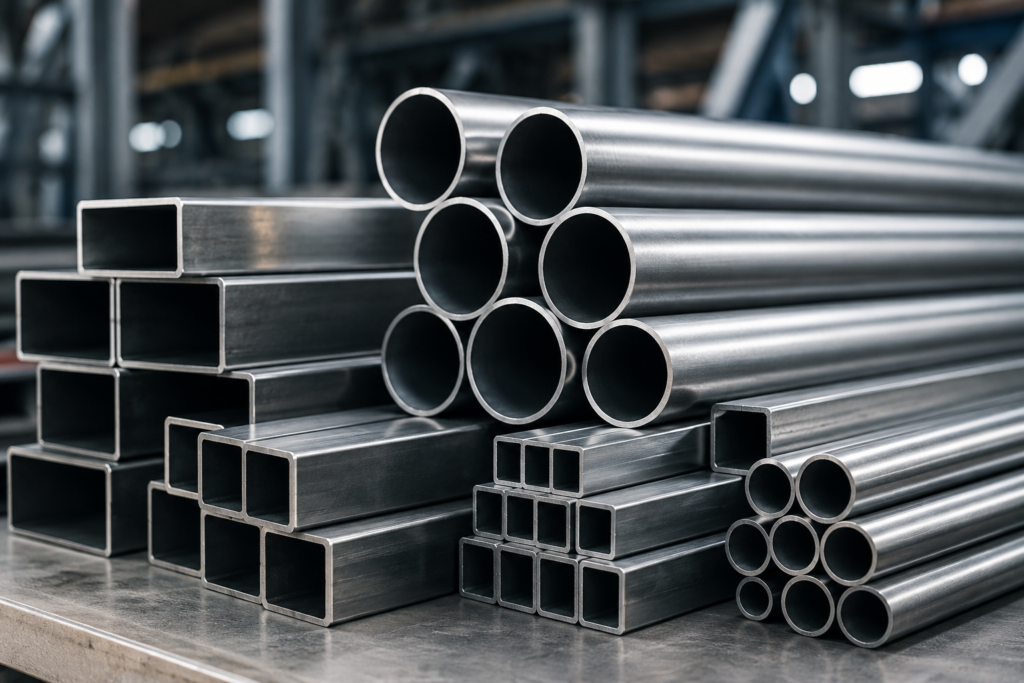
CRC Round Pipes specifically refer to cylindrical steel tubes manufactured through this cold-rolling process. They’re celebrated for their:
- Tight dimensional tolerances
- Smooth, clean surface finish
- Higher tensile strength compared to HRC equivalents
- Excellent weldability and machinability
CRC Oval Pipes follow the same manufacturing philosophy, just with an elliptical cross-section — used in applications where aesthetics and aerodynamics matter alongside structural integrity, such as furniture, automotive frames, and decorative architecture.
CRC vs. HRC: What’s the Difference?
| Parameter | CRC (Cold Rolled Close Annealed) | HRC (Hot Rolled Coil) |
| Manufacturing Temp | At or near room temperature | Above recrystallisation temp (~900°C+) |
| Surface Finish | Smooth, clean, mill-scale free | Rough, with mill scale |
| Dimensional Accuracy | High (tighter tolerances) | Moderate |
| Tensile Strength | Higher | Slightly lower |
| Typical Use | Precision parts, furniture, automotive | Heavy structural work, beams |
| Cost | Slightly higher | Lower |
Why CRC Round & Oval Pipes Are the Go-To Choice for Industrial Use
It’s not just about specs on paper. In real-world industrial applications, the properties of CRC pipes translate into tangible benefits that impact your bottom line and project outcomes.
Key Benefits at a Glance
| Feature | What It Means for You | Industry Application |
| Smooth Surface Finish | Less post-processing needed; ready for painting or plating | Furniture, automotive |
| Tight Tolerances | Fits seamlessly into precision assemblies | Engineering, machinery |
| High Strength | Withstands stress without deformation | Structural, construction |
| Consistent Wall Thickness | Uniform load distribution; reliable performance | Hydraulic systems |
| Excellent Weldability | Faster fabrication; fewer defects | Manufacturing plants |
| Aesthetic Appeal (Oval) | Cleaner look for visible applications | Décor, retail fixtures |
How to Choose the Right CRC Round Pipes Supplier
Not all steel suppliers are created equal. The market is flooded with options, and the wrong choice can cost you far more than the price difference you hoped to save. Here’s a structured approach to evaluating any CRC Round Pipes Supplier before placing a bulk order.
Step-by-Step Supplier Evaluation Process
| Step | Action | Why It Matters |
| Step 1: Verify Certifications | Ask for IS/BIS, ISO, or relevant quality certifications | Ensures the product meets national/international standards |
| Step 2: Check Product Range | Confirm they supply the specific grades, sizes, and finishes you need | Avoids sourcing from multiple vendors |
| Step 3: Request Material Test Reports | Ask for mill test certificates (MTCs) | Validates chemical composition and mechanical properties |
| Step 4: Evaluate Lead Times | Ask about stock availability and delivery timelines | Keeps your project on schedule |
| Step 5: Compare Pricing Transparently | Request itemised quotations (material + cutting + delivery) | Avoids hidden cost surprises |
| Step 6: Check After-Sales Support | Assess their responsiveness and return/replacement policy | Protects you if there are defects or shortfalls |
Tips & Best Practices When Buying CRC Pipes
Always Specify Your Grade: CRC pipes come in various steel grades (e.g., IS 1079, CRCA Grade D, etc.). Be specific with your supplier — vague orders lead to mismatched deliveries.
Order with Tolerance in Mind: Factor in a small buffer stock (typically 5–8%) for offcuts, wastage, and last-minute design changes. This avoids emergency top-up orders at higher spot prices.
Request Sample Pieces First: Before committing to a large order, ask your CRC Oval Pipes Supplier or round pipes supplier for sample lengths. Inspect surface finish, end squareness, and wall uniformity.
Prioritise Suppliers with In-House Testing: Suppliers who test their own products are more accountable for consistency. Ask if they have an in-house lab or work with a certified third-party testing agency.
Think Long-Term, Not Just Low Price: The cheapest quote rarely reflects the true cost. Factor in rejects, delays, and rework when comparing suppliers. Quality-first sourcing always pays off over time.
Common Mistakes Buyers Make (And How to Avoid Them)
Ignoring Wall Thickness Variations: Some suppliers cut costs by reducing wall thickness slightly below spec. Always cross-check physical measurements against the MTC.
Choosing Based on Price Alone: A lower price often signals compromised raw material or skipped quality checks. In load-bearing applications, this can be dangerous.
Not Confirming Delivery Terms: “Delivery in 7 days” can mean different things. Confirm whether that’s from the order date, payment date, or dispatch date — and whether it includes unloading.
Overlooking Packaging Quality: Improper packaging leads to surface scratches, dents, and corrosion in transit. Ask how the pipes are bundled and whether rust-preventive coating is applied.
Do’s and Don’ts Quick Reference
| Category | Do This | Avoid This |
| Documentation | Always request Mill Test Certificates | Don’t accept pipes without traceability |
| Specification | Specify grade, OD, wall thickness clearly | Don’t leave specs vague or “standard” |
| Supplier Vetting | Visit or audit the supplier facility if possible | Don’t rely solely on online catalogues |
| Payments | Use milestone-based payment terms | Don’t pay 100% upfront for first orders |
| Receiving | Inspect every lot before signing off | Don’t skip incoming quality checks |
Why Vardhman Steel Tubes is a Trusted Name in the Industry
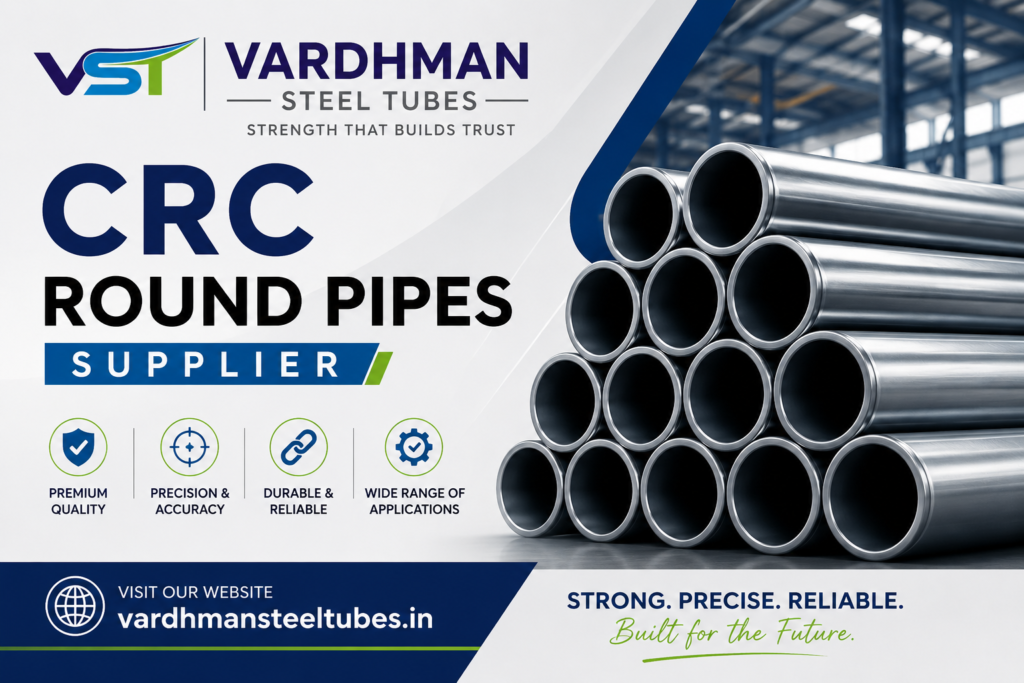
When businesses look for a dependable CRC Round Pipes Supplier in India, Vardhman Steel Tubes consistently comes up as a preferred partner — and for good reason.
With years of experience serving industries ranging from construction and automotive to furniture manufacturing and engineering fabrication, Vardhman has built a reputation for consistent quality, on-time delivery, and transparent business practices.
Here’s what makes them stand out:
- Wide product range: CRC Round Pipes, CRC Oval Pipes, ERW tubes, and more — all under one roof
- Strict quality control: Each batch undergoes dimensional, visual, and mechanical testing before dispatch
- Pan-India supply network: Capable of fulfilling both bulk and repeat orders across regions
- Certified materials: Products sourced from reputed steel mills and backed by proper documentation
- Customer-first approach: Responsive team with clear communication at every stage of the order
Whether you need a one-time consignment or a long-term supply partnership, Vardhman Steel Tubes brings the reliability that industrial projects demand.
Frequently Asked Questions (FAQ)
Q1. What is the difference between CRC Round Pipes and ERW pipes?
CRC (Cold Rolled Close Annealed) pipes are manufactured through a cold-rolling and annealing process that gives them a smoother finish and tighter tolerances. ERW (Electric Resistance Welded) pipes are made by rolling steel strips and welding the seam using electrical resistance. CRC pipes are generally preferred for precision and aesthetic applications, while ERW pipes are common in structural and plumbing uses.
Q2. In which industries are CRC Oval Pipes most commonly used?
CRC Oval Pipes are widely used in furniture manufacturing (chair and table legs), automotive components, decorative architectural elements, retail display fixtures, and gym equipment — wherever a sleek cross-section and smooth surface are important.
Q3. What certifications should a good CRC Round Pipes Supplier have?
Look for suppliers who adhere to BIS (Bureau of Indian Standards) norms, hold ISO 9001 quality management certification, and can provide Mill Test Certificates (MTCs) for each batch they supply. These documents confirm the material’s chemical and mechanical properties.
Q4. How do I know if the wall thickness of the pipe is accurate?
The most reliable method is to use an ultrasonic wall thickness gauge or a vernier calliper on cut sections of the pipe. Always cross-reference your physical measurements with the Mill Test Certificate. Reputed suppliers like Vardhman Steel Tubes provide documentation that aligns with actual product dimensions.
Q5. Can CRC pipes be customised in terms of length and finish?
Yes. Most established CRC Round Pipes Suppliers offer cut-to-length services and can supply pipes in various surface finishes such as natural mill finish, oil-coated (rust preventive), or pre-painted depending on your end application.
Q6. What is the minimum order quantity for CRC pipes from Vardhman Steel Tubes?
Minimum order quantities can vary depending on the pipe size, grade, and destination. It’s best to reach out directly to the Vardhman Steel Tubes team for accurate MOQ details and to discuss project-specific requirements.
Conclusion: The Right Supplier Is Half the Job Done
Choosing a CRC Round Pipes Supplier isn’t just a procurement decision — it’s a quality decision that echoes throughout your entire project or production line. Get it right, and you’re working with pipes that fit perfectly, weld cleanly, and hold up under load. Get it wrong, and you’re dealing with rework, delays, and unnecessary cost overruns.
The good news? The checklist isn’t complicated. Verify certifications, request test reports, sample before you commit, and work with a supplier who values transparency as much as you do.
Vardhman Steel Tubes has built its reputation on exactly those principles — delivering quality CRC Round Pipes and CRC Oval Pipes to industrial buyers across India with consistency and care. If you’re ready to source smarter, they’re worth talking to.
Ready to Source High-Quality CRC Pipes?
Connect with Vardhman Steel Tubes — your trusted CRC Round Pipes and Oval Pipes Supplier for industrial-grade solutions across India.
Get customised quotes, technical guidance, and on-time delivery — all from one reliable partner.
Contact us Vardhman Steel Tubes Today