AdminVardhaman

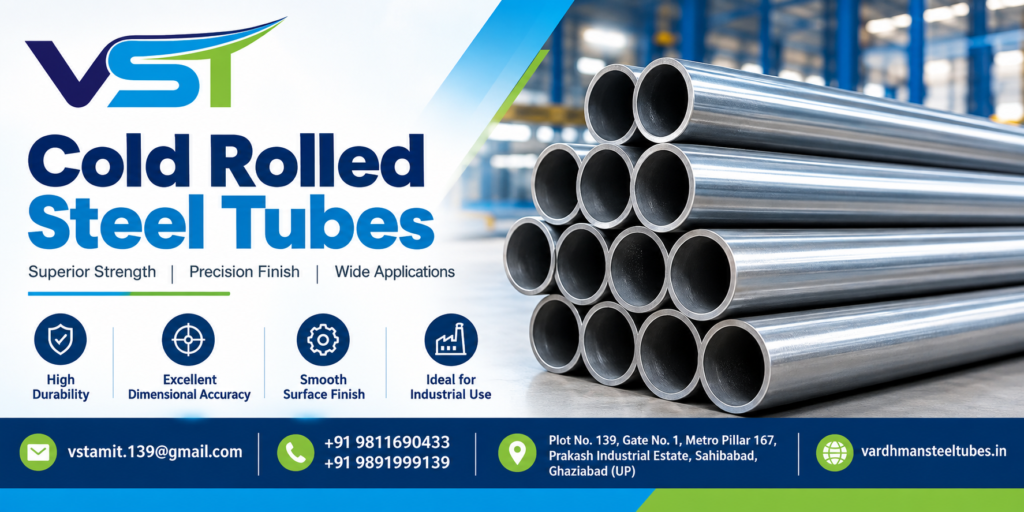
Cold Rolled Steel Tubes

Cold Rolled Steel Tubes: Benefits, Uses & Buying Guide

If you fabricate furniture frames, build e-rickshaw bodies, assemble storage racks or manufacture machine enclosures, the tube you start with decides how much work comes later. A tube that arrives with an uneven surface or inconsistent dimensions costs you extra grinding, extra filler, extra rejections and slower assembly. That is the practical reason cold rolled steel tubes are so widely specified across Indian manufacturing. They are chosen where appearance, accurate fitting and clean finishing matter as much as strength. This guide explains what Cold Rolled Steel Tubes are, how they differ from other steel tube options, where they are typically used, and what to confirm before you place an order. Vardhman Steel Tubes, based in Ghaziabad, Uttar Pradesh, supplies CRC pipes, tubes and sheets to buyers across these segments, and the buying advice below reflects the questions fabricators ask most often. What Are Cold Rolled Steel Tubes? Cold rolled steel is steel that has been further processed at or near room temperature after hot rolling. Hot rolled steel is formed at high temperature, which leaves a rougher, scaled surface and wider dimensional variation. Cold rolling passes that material through rollers again without reheating, which reduces thickness, tightens tolerances and produces a cleaner, smoother surface. Cold rolled steel tubes, commonly called CRC tubes or CRC steel tubes, are tubes formed from this cold rolled material. The strip is shaped into a round, square, rectangular or oval profile and joined along a seam. Because the input material already has controlled thickness and a refined surface, the finished tube carries those characteristics forward. Three qualities follow from the process: Dimensional consistency. Outside dimensions and wall thickness stay within closer limits across a batch, so parts cut from different lengths fit the same jig. Surface characteristics. The outer surface is typically smooth and free of heavy mill scale, which makes it more receptive to painting, powder coating, plating or polishing. Predictable working behaviour. Cold working increases hardness and strength while reducing ductility compared to the same steel in hot rolled condition. This matters when the tube will be bent or formed. Actual mechanical properties, tolerances and suitability always depend on the specific grade, the manufacturing route and the dimensions supplied. Confirm these with your supplier rather than assuming them. Cold Rolled Steel Tubes vs. Other Steel Tubes Factor Cold Rolled Steel Tubes Other Steel Tube Options (e.g. hot rolled based) Surface finish Generally smooth and clean, with minimal scale Often rougher; may carry mill scale needing cleaning Dimensional accuracy Tighter, more consistent dimensions and wall thickness Wider permissible variation Appearance Suitable for visible and decorative components Usually needs surface preparation before finishing Fabrication Cuts, drills and assembles predictably; bending behaviour depends on grade and temper Often more ductile for heavy forming; may need extra prep Typical applications Furniture, interiors, light engineering, precision assemblies Structural work, heavy sections, load-bearing frameworks Relative cost Usually higher per kg due to additional processing Generally lower for comparable size Neither category is universally better. Suitability depends on grade, process, dimensions and the end application. A heavy structural column and a hospital bed frame have genuinely different requirements. Key Benefits of Cold Rolled Steel Tubes Smooth Surface Finish When a tube stays visible in the finished product, surface quality is the product. Chair frames, showroom displays, interior railings, hospital furniture and e-rickshaw bodies are all judged on how the paint or coating looks. A smooth base surface means less grinding and filling, more even coating coverage and fewer visible defects after finishing. This is a major reason cold rolled tubes are preferred for downstream painting, powder coating and polishing. Dimensional Accuracy Consistent outside dimensions and wall thickness allow repeatable production. Jigs and fixtures hold parts the same way every time, welding gaps stay predictable, and CNC or automated cutting produces parts that fit without individual adjustment. For anyone running batch production, this consistency directly reduces rework. Ease of Fabrication Cold rolled tubes generally cut, drill, notch, weld and assemble in a predictable way, which is what fabrication shops value most. Predictability lets you set process parameters once and repeat them. That said, weldability and formability depend on the specific grade, wall thickness and the process used. Discuss demanding operations, tight-radius bending in particular, with your supplier before committing to a large order. Versatile Applications CRC tubes are available in a wide range of profiles and sizes, including square, rectangular, round and oval, in varying wall thicknesses and lengths. This range is why the same family of industrial steel tubes serves furniture workshops, engineering units and equipment manufacturers alike. You select the section that suits your load, span and appearance requirement rather than adapting your design to what is available. Suitable for Precision-Oriented Applications Where components must fit into sleeves, slide within assemblies, accept fixed-dimension fittings or align across multi-part frames, small dimensional variation creates real problems. Tighter tolerances and consistent wall thickness make cold rolled tubes a practical choice for these precision-oriented steel tubes for engineering applications, provided the required tolerance is specified and confirmed in advance. Applications of Cold Rolled Steel Tubes Common applications where CRC tubes are routinely used: Applications requiring specific engineering specifications: Automotive-related components, load-bearing structural elements, pressure-carrying lines and safety-critical assemblies are governed by defined material grades, mechanical property requirements and testing standards. For these, the correct approach is to state your specification and confirm that the available material meets it, rather than selecting a tube by size and appearance alone. How to Choose the Right Cold Rolled Steel Tubes Dimensions and Wall Thickness Specify outside dimensions precisely: diameter for round tubes, both sides for square and rectangular sections. State wall thickness separately. Two tubes with identical outer dimensions but different wall thickness behave very differently in weight, strength and welding. Material Requirements Confirm the material grade or specification your application needs. If your drawing, customer or approving authority names a grade, share it upfront. If you are unsure, describe the application and ask what is available and suitable. Surface Finish State clearly whether

Cold Rolled Steel Tubes: Benefits, Uses & Buying Guide Read More »
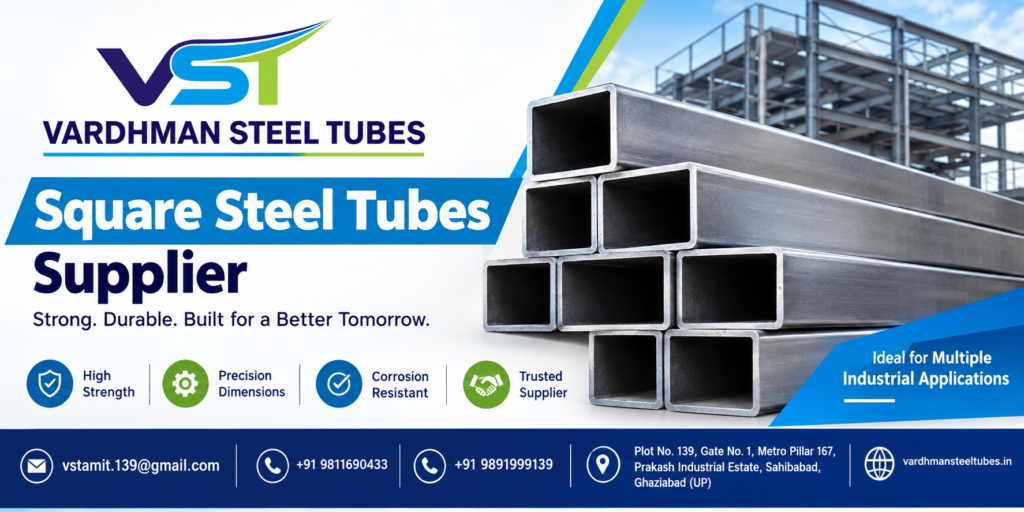
Square Steel Tubes Supplier

Square Steel Tubes Supplier for Fabrication and Construction

Square steel tubes are hollow structural sections with equal-sided profiles, used in fabrication and construction for their strength, dimensional consistency, and ease of welding. When choosing a Square Steel Tubes Supplier, buyers should confirm dimensions, wall thickness, surface finish, and delivery capability before placing an order. Square steel tubes have quietly become one of the most relied-upon materials in fabrication workshops and construction sites across India. Their straight edges and consistent cross-section make them easier to work with than many other steel profiles, which is why they show up in everything from factory racking to gate frames. As construction activity and industrial fabrication continue to grow, more contractors, fabricators, and procurement teams are searching for a dependable Square Steel Tubes Supplier who can supply consistent material on time. This guide walks through what square steel tubes are, where they are used, and what to check before you place an order — whether you’re sourcing a small batch for a workshop project or planning bulk procurement for a larger job. What Are Square Steel Tubes? Square steel tubes are hollow structural sections manufactured with equal width and height, giving them a uniform square cross-section along their length. This geometry is achieved through controlled steel-forming processes that aim for consistent wall thickness and straightness across each piece. Key characteristics that fabricators and engineers look for include: The square geometry is particularly useful in fabrication and structural work because flat faces allow for simpler joints, cleaner welds, and easier attachment of brackets, panels, or fittings — something round tubes don’t offer as naturally. Why Use Square Steel Tubes for Fabrication? Fabricators generally prefer square steel tubes over several alternative steel forms for a few practical reasons. Easy cutting and welding. The flat sides allow for straightforward cuts at standard angles and clean, accessible weld joints, which speeds up shop-floor work. Efficient fabrication. Because dimensions are consistent, fabricators can plan cutting lists and assemblies with fewer surprises, reducing rework. Structural stability. The closed, square cross-section distributes load reasonably evenly, which is one reason square tubes are common in frames that need to resist both vertical loads and lateral forces. Suitable for frames and fabricated components. Square tubes form clean right angles naturally, which is useful when building frames, enclosures, or supports that need square corners. Clean and uniform appearance. For visible fabricated products — trolleys, racks, furniture frames — the flat, even surface of square tubing gives a tidier finished look than irregular profiles. Ease of handling and assembly. Square tubes stack, store, and transport predictably, which simplifies site logistics compared to bundles of irregularly shaped material. Applications of Square Steel Tubes in Construction In construction, square steel tubes are used where a straightforward structural profile with flat mounting faces is helpful. Common applications include: It’s worth noting that not every square tube size or thickness is suitable for every structural purpose. Load-bearing applications, in particular, require the buyer or a structural engineer to confirm that the chosen dimensions and thickness match the actual loads and safety margins of the project — a supplier can advise on available specifications, but structural design decisions should involve qualified engineering input. Applications in Fabrication and Engineering Beyond construction sites, square steel tubes are widely used across general engineering and fabrication workshops, including: Vardhman Steel Tubes lists square tubes as part of its CRC (Cold Rolled Coil) product range, alongside CRC pipes, CRC sheets, round pipes, and oval pipes, with applications spanning construction, general engineering, fabrication, and infrastructure use. How to Choose the Right Square Steel Tubes Supplier Selecting a supplier is as important as selecting the material itself. Before placing an order, it helps to work through the following points: Why Supplier Reliability Matters A dependable square steel tube supplier does more than deliver material — it directly affects how smoothly a project runs. Consistent product specifications mean fabricators don’t need to re-check or re-work incoming stock. Reliable suppliers also make project planning easier, since contractors can schedule fabrication stages around confirmed delivery windows rather than guesswork. For businesses with bulk or recurring requirements, working with the same supplier over time also builds familiarity — the supplier understands your typical specifications, and repeat procurement becomes faster. Timely communication about stock availability or delays helps avoid last-minute disruptions, and consistent quality reduces the material-related delays that come from rejecting or replacing mismatched batches. Why Consider Vardhman Steel Tubes? Vardhman Steel Tubes is based in Ghaziabad, Uttar Pradesh, and was established in 2023. The company supplies and trades CRC steel products, including CRC pipes, CRC tubes, CRC sheets, square tubes, round pipes, and oval pipes, catering to industries such as construction, general engineering, fabrication, and infrastructure. For buyers exploring the CRC Tubes and CRC Pipes ranges, along with CRC Sheets, Vardhman Steel Tubes offers these as part of its broader product catalog. You can learn more about the company’s background on the About Us page, or reach out directly through the Contact Us page for specification-related queries. Factors to Check Before Ordering Square Steel Tubes Use the checklist below before finalizing any order, whether it’s a small batch or a bulk requirement. Factor What to Confirm Required dimensions Exact outer size (width x height) matching your design or application Wall thickness Thickness suited to the expected load and fabrication method Quantity Total length or number of pieces, with some allowance for cutting waste Application Whether the tube is for structural, decorative, or general fabrication use Surface/finish requirements Whether a smoother CRC finish or standard finish is needed Fabrication method Whether the tubes will be welded, bolted, cut, or bent Delivery requirements Site accessibility, timeline, and packaging needs Supplier specifications and documentation Availability of specification sheets or product details for your records Going through this list before ordering helps reduce mismatched deliveries and avoids project delays caused by re-ordering. Frequently Asked Questions What are square steel tubes used for?  Square steel tubes are used in fabrication and construction for structural frames, railings, gates, machinery frames, storage racks, and various

Square Steel Tubes Supplier for Fabrication and Construction Read More »

Steel for Construction Industry

Steel for Construction Industry: Benefits & Applications

Steel remains one of the most relied-upon materials in construction because it offers a practical balance of strength, workability, and consistency. Whether it’s a structural framework, a fabricated railing, or an industrial support system, Steel for Construction Industry use gives builders and fabricators a material that performs predictably under load, welds cleanly, and holds its shape over time. Choosing the right steel tubes and pipes — with the correct grade, dimensions, and finish — directly affects fabrication efficiency, structural reliability, and how long a project performs before maintenance is needed. Quick Answer Steel is used in construction for structural frameworks, railings, gates, equipment supports, and fabricated components because it offers high strength, dimensional consistency, and fabrication flexibility. Steel tubes and pipes can be cut, welded, and formed into different profiles, making them suitable for both load-bearing structures and lighter architectural or industrial fabrication work. What is Steel Used for in the Construction Industry? Steel plays two broad roles in construction: structural and fabricational. In structural applications, steel sections and tubes are used for building frameworks, load-bearing supports, and construction machinery bases where strength and stability under load are the primary requirement. In fabrication applications, steel tubes are used for railings, gates, grills, partitions, and equipment structures where the focus is on precise dimensions, clean welds, and a good surface finish rather than heavy load-bearing capacity. Understanding this distinction matters because not every steel product is designed for the same purpose. A tube well suited for a decorative railing may not be the right choice for a load-bearing column, and vice versa. Matching the product to the application is the first step in any steel-buying decision. Top Benefits of Steel for Construction Industry Applications Strength and Structural Performance Steel is widely selected wherever strength-to-weight performance matters. It can carry substantial loads relative to its cross-sectional size, which is why it is common in frameworks, supports, and structures that need to resist bending, compression, or dynamic loads over time. Durability Steel’s service life depends heavily on correct grade selection, proper fabrication practices, appropriate surface finishing, and routine maintenance. A well-selected and well-finished steel product can perform reliably for years, while an unsuitable grade or poor finishing choice in a harsh environment can shorten service life considerably. Fabrication Flexibility One of steel’s biggest practical advantages is how easily it can be cut, welded, drilled, bent, and assembled. This flexibility allows fabricators to adapt standard tube stock to a wide range of project-specific designs without needing entirely custom raw material. Dimensional Consistency Consistent outer dimensions and wall thickness are essential when components need to fit together accurately — for example, in modular frameworks or assemblies with multiple joints. Inconsistent tubing can cause alignment issues, uneven welds, and rework during fabrication. Efficient Material Usage Hollow steel tubes can offer efficient material usage for certain applications, since they provide useful strength while using less material than an equivalent solid section. This is not a universal rule — solid sections remain the better choice for some structural requirements — but where appropriate, tubes can reduce weight and material cost without compromising the intended function. Design Versatility Round, square, and rectangular steel tube profiles each suit different design and structural needs. Round tubes are common in railings and frames, square tubes are often used in structural framing and fabrication, and rectangular tubes are useful where flat mounting surfaces or specific load orientations are needed. Steel Tubes and Pipes Used in Construction Steel Product Typical Characteristics Example Applications Round Steel Tubes Uniform strength in all directions, easy to weld and bend Railings, frames, supports Square Steel Tubes Flat surfaces for mounting and joining, good torsional strength Frames, structures, fabrication Rectangular Tubes Directional strength, flat top and bottom surfaces Frameworks and equipment CRC Tubes/Pipes Smooth finish, close dimensional tolerance Precision fabrication and suitable construction-related applications Role of CRC Steel Products in Construction & Fabrication Cold Rolled Coil (CRC) steel is processed at room temperature after initial hot rolling, which gives it a smoother, brighter surface finish and tighter dimensional accuracy compared to hot-rolled products. CRC pipes and tubes are known for their consistent wall thickness, close tolerances, and clean appearance, which makes them well suited for applications where fit and finish matter. As a CRC steel products supplier, Vardhman Steel Tubes notes that its CRC pipes and tubes are used across several fabrication categories, including furniture manufacturing, e-rickshaw manufacturing, gym equipment, automotive parts, and other fabricated products. These are largely appearance- and precision-driven applications rather than heavy structural, load-bearing construction uses. In construction-related work, CRC tubes are more commonly found in interior fabrication, railings, and equipment structures where a smooth finish and accurate dimensions are priorities, rather than in primary structural framing. Applications of Steel in Construction Building Frameworks Structural steel sections and fabricated components are used to form building frameworks, providing the skeleton that supports floors, roofs, and walls in many construction types. Railings and Safety Structures Steel tubes are widely used for stair railings, balcony guards, and safety barriers, where consistent dimensions and clean welds contribute to both appearance and safety. Gates and Grills Steel tubes are a practical choice for fabricated gates and grills because they can be cut and welded into custom patterns while offering enough rigidity for daily use. Interior and Architectural Fabrication Furniture frames, partitions, display structures, and decorative elements often rely on steel tubes for their combination of strength, workability, and finish. Industrial Construction In industrial settings, steel tubes and sections support equipment platforms, machinery frames, and other fabricated structures where load-bearing capacity and dimensional accuracy both matter. How to Choose the Right Steel for a Construction Project Each of these factors interacts with the others, so it’s worth reviewing them together rather than focusing on price or dimensions alone. Steel Tubes for Fabrication: What Buyers Should Know Fabricators should evaluate several practical factors before ordering steel tubes, including cutting requirements, the intended welding method, dimensional tolerance, straightness, surface condition, finishing needs, and expected production volume. A tube that is slightly out

Steel for Construction Industry: Benefits & Applications Read More »

Steel Pipes for Industrial Use

Steel Pipes for Industrial Use: Everything You Need to Know Before You Buy

Buying Steel Pipes for Industrial Use is rarely as simple as picking a diameter and placing an order. The right pipe depends on the application, the load it needs to bear, the fabrication process it will go through, and the finish the end product requires. Getting these details wrong can mean rework, wasted material, or a product that fails to perform once it’s in the field. This guide walks through what industrial buyers, fabricators, and procurement teams should check before purchasing steel pipes, and how different pipe types — including CRC pipes and cold rolled steel tubes — fit different jobs. Before buying steel pipes for industrial use, confirm the outside diameter, wall thickness, length, and steel grade required for your application. Check surface finish and dimensional tolerance if the pipe will be welded or machined, verify quality documentation, and choose a supplier who can consistently deliver the specified dimensions and grade on time. What Are Steel Pipes for Industrial Use? Steel pipes for industrial use are hollow steel sections manufactured for structural, mechanical, or fabrication purposes rather than for carrying fluids under pressure, as many pressure-rated pipelines are. They are used to build frames, supports, machine parts, and structural components across manufacturing, construction, and automotive work. Industrial steel pipes differ mainly based on how they are manufactured and finished. Hot rolled pipes go through a hot-forming process and typically have a rougher surface and looser dimensional tolerance. Cold rolled steel pipes, often referred to as CRC pipes (Cold Rolled Coil pipes), are further processed at room temperature after the initial rolling stage. This additional step improves surface finish, wall thickness uniformity, and dimensional accuracy. CRC pipes and cold rolled steel tubes are commonly chosen where a smooth surface and consistent wall thickness matter — for example, in furniture frames, e-rickshaw manufacturing, gym equipment, and general fabrication work. Their dimensional consistency makes cutting, welding, and bending more predictable, which reduces fitment issues during assembly. Dimensions, wall thickness, material grade, and surface finish all matter because each one affects how the pipe behaves under load, how easily it can be worked with tools, and how it looks in a finished product. A pipe that is dimensionally accurate but under-specified for load will fail in service; a pipe that is over-specified adds unnecessary cost. Key Benefits of Steel Pipes for Industrial Applications Steel pipes are widely used in industrial settings because, when correctly specified, they offer: These benefits are not universal across every pipe on the market. A pipe’s actual performance depends on its grade, wall thickness, manufacturing process, and how well it matches the intended application. A pipe suited for light furniture fabrication is not automatically suited for heavy structural or load-bearing work, and buyers should confirm specifications against their own requirements rather than assuming general benefits apply. Common Applications of Industrial Steel Pipes Manufacturing Industrial steel pipes are used in machine components, equipment frames, supports, storage cabinets, and various fabricated parts where dimensional accuracy affects assembly and function. Fabrication Fabricators rely on steel pipes and tubes to build frames, racks, trolleys, supports, and structural assemblies. Customized fabricated products, from workstations to enclosures, are often built around square and rectangular tube sections. Automotive and Transportation Round and shaped pipes are used in chassis-related components, body frames, and support structures, including applications such as roll cages and other vehicle sub-assemblies where consistent wall thickness supports welding quality. Construction and Infrastructure Steel pipes appear in railings, gates, scaffolding-related structures, and other structural components used across residential and commercial construction. CRC square tubes and round pipes are commonly used for gates, grills, and support structures where a clean finish is visible in the final installation. CRC Pipes vs. Other Steel Pipes Choosing between CRC pipes and other steel pipe options depends on what the application demands. Neither is a universal replacement for the other. Factor CRC Pipes Other Steel Pipe Options (e.g., Hot Rolled) Surface Finish Smooth, consistent finish suited to visible or coated components Generally rougher, may need additional finishing Dimensional Accuracy Tighter tolerances due to cold rolling process Wider tolerances, acceptable for less precision-sensitive work Fabrication Predictable welding and bending due to uniform wall thickness Workable, but variation in thickness can affect consistency Typical Applications Furniture, fabrication, engineering components, automotive parts Heavy structural work, larger-diameter structural pipes Best Use Case Applications needing surface quality and dimensional precision Applications prioritizing bulk strength over surface finish The correct choice depends on the application’s technical requirements, not on one product being categorically better than the other. What to Check Before Buying Steel Pipes A practical buyer’s checklist helps avoid costly mismatches between what is ordered and what the job actually needs. Each of these factors interacts with the others — for instance, a longer length combined with a thinner wall may need extra handling care during transport and fabrication. How to Choose a Reliable Industrial Steel Supplier A supplier’s reliability affects project timelines as much as the product specification does. When evaluating an industrial steel pipe supplier, buyers should look at: Vardhman Steel Tubes, based in Ghaziabad, Uttar Pradesh, supplies and trades CRC pipes, CRC tubes, CRC sheets, square tubes, round pipes, and oval pipes for industrial and commercial requirements. As an industrial steel supplier working across construction, fabrication, engineering, and automotive-related applications, the focus stays on matching product specifications to what each buyer’s project actually needs, rather than pushing a one-size-fits-all product. Common Buying Mistakes to Avoid Several recurring mistakes lead to project delays or unusable material: Practical Buying Example Consider a fabrication workshop building furniture frames that will be powder-coated. The workshop needs a pipe with a smooth outer surface for good coating adhesion, consistent wall thickness for predictable welding at joints, and moderate strength since the frames won’t bear heavy structural loads. In this case, a cold rolled CRC round or square pipe in a lighter wall thickness is likely to be more suitable than a hot rolled pipe, since the surface finish and dimensional consistency matter more here than raw

Steel Pipes for Industrial Use: Everything You Need to Know Before You Buy Read More »

Steel Tubes for Fabrication

Steel Tubes for Fabrication: Complete Buying Guide

If you’ve ever stood in front of a steel supplier’s catalogue trying to decide which tube to order, you know the feeling — rows of specs, grades, and sizes, and no clear idea which one actually fits your job. Pick the wrong tube and you either overpay for strength you don’t need, or worse, end up with a structure that can’t handle the load it was built for. This is a more common problem than most people admit. Fabricators, contractors, and even engineers sometimes default to “whatever we used last time” instead of matching the tube to the actual application. It works — until it doesn’t. This guide breaks down everything you need to know about Steel Tubes for Fabrication — the types, the grades, how to choose the right one, and the mistakes that quietly cost fabricators time and money. Whether you’re building a structural frame, furniture, machinery parts, or industrial equipment, you’ll walk away knowing exactly what to ask your supplier for. What Are Steel Tubes for Fabrication? In simple terms, fabrication-grade steel tubes are hollow steel sections manufactured to be cut, welded, bent, and shaped into finished structures or components. Unlike pipes, which are primarily meant to carry fluids or gases, fabrication tubes are chosen for their strength, shape consistency, and how well they hold up under welding and mechanical stress. You’ll find them in everything from building frames and staircases to trailer chassis, machine guards, conveyor systems, and even gym equipment. The reason steel tubes are so widely used comes down to three things: they’re strong relative to their weight, they’re easy to work with, and they give a clean, professional finish once fabricated. Common Types of Steel Tubes Used in Fabrication Not all tubes are built the same way, and the manufacturing process changes how the tube behaves once it’s in your workshop. Common Shapes You’ll Come Across Steel tubes for fabrication generally come in four shapes — round, square, rectangular, and oval. Each shape serves a different structural purpose, which is exactly why picking the right one matters more than people expect. Quick Comparison: Tube Types at a Glance Tube Type Best For Strength Level Cost ERW Tubes General fabrication, structural framing Medium-High Economical Seamless Tubes High-pressure, precision components High Premium Cold-Formed Tubes Furniture, precision fabrication Medium Moderate Hot-Rolled Tubes Heavy structural work High Economical Note: Actual strength and cost vary by grade, wall thickness, and supplier. Use this as a starting reference, not a final spec. Key Benefits of Using the Right Steel Tubes Choosing correctly-specified tubes isn’t just a technical checkbox — it directly affects your project’s cost, timeline, and long-term durability. How to Choose the Right Steel Tube: A Step-by-Step Approach You don’t need to be a metallurgist to make a smart decision. You just need to ask the right questions in the right order. Step-by-Step Selection Process Step What to Determine Why It Matters 1. Define load requirement Static, dynamic, or impact load Determines wall thickness and grade needed 2. Choose shape Round, square, rectangular, oval Affects load distribution and aesthetics 3. Select grade Mild steel, structural, or alloy grade Impacts strength, weldability, corrosion resistance 4. Check environment Indoor, outdoor, humid, corrosive Decides if coating or galvanization is needed 5. Confirm supplier standards Certifications, tolerances, testing reports Ensures consistent, reliable batches Note: Following this order prevents the most common planning mistake — picking a shape or size before the load requirement is even defined. Tips and Best Practices for Buying Fabrication Tubes Do’s and Don’ts Checklist Do Don’t Verify grade and thickness against your load calculations Assume all tubes of the same size are interchangeable Request certification and test reports from your supplier Buy purely on price without checking quality documentation Factor in the fabrication environment (indoor/outdoor) Ignore corrosion protection for outdoor structures Store tubes properly before use Leave tubes exposed to moisture for long periods Note: Most fabrication failures trace back to one of these avoidable mistakes, not a flaw in the steel itself. Common Mistakes to Avoid Even experienced fabricators fall into a few recurring traps: Buying Guide Checklist Checklist Item Confirmed? Load requirement calculated ☐ Correct grade and shape selected ☐ Mill test certificate requested ☐ Corrosion protection considered ☐ Supplier reliability verified ☐ Note: Keep this checklist handy for every new fabrication project — it takes minutes but saves rework later. Frequently Asked Questions 1. What’s the difference between steel tubes and steel pipes?Pipes are primarily designed to carry liquids or gases and are sized by internal diameter. Tubes are measured by outer dimensions and are chosen mainly for structural strength and shape precision in fabrication work. 2. Which steel tube grade is best for general fabrication work?For most general structural and fabrication jobs, mild steel ERW tubes offer a strong balance of cost, weldability, and strength. Higher-stress or precision jobs may call for alloy or seamless grades. 3. Do steel tubes need extra coating for outdoor use?Yes, in most cases. Uncoated tubes exposed to moisture or humidity will corrode faster. Galvanized or painted tubes are recommended for outdoor structures, railings, or equipment. 4. How do I know what wall thickness I need?Wall thickness depends on the load the tube will carry and the span or length involved. It’s best calculated based on your specific application, ideally with input from a structural engineer or an experienced supplier. 5. Can steel tubes be bent without losing strength?Yes, when done correctly. Cold-formed and certain mild steel tubes bend well without cracking, but the bend radius and technique used matter — tight, improper bends can weaken the tube at the curve. 6. How do I verify tube quality before purchasing in bulk?Ask your supplier for mill test certificates, check for consistent surface finish and dimensional accuracy, and if possible, request a small sample batch before committing to a full order. Final Thoughts Picking the right steel tube isn’t about finding the “best” tube in some universal sense — it’s about matching the tube to your specific load, environment,

Steel Tubes for Fabrication: Complete Buying Guide Read More »

CRC Steel Products in India

CRC Steel Products in India: Types, Uses & Applications Explained

CRC (Cold Rolled Coil/Close Annealed) steel is hot-rolled steel that’s further processed at room temperature to achieve a smoother finish, tighter dimensional tolerance, and higher strength. In India, CRC Steel Products — mainly pipes, tubes, and sheets — are used across construction, automotive, furniture, general engineering, and infrastructure industries because they’re easier to weld, shape, and fabricate than standard hot-rolled steel. Introduction If you’ve ever compared two steel components and noticed one has a noticeably smoother, more precise finish, there’s a good chance it was made from CRC steel. Cold Rolled Coil (CRC) steel products have become the go-to choice for manufacturers, fabricators, and builders across India who need materials that combine strength with dimensional accuracy. This guide breaks down what CRC steel actually is, the different product types available in the Indian market, their real-world applications, and how to pick a reliable supplier — so whether you’re an engineer, a procurement manager, or a first-time buyer, you’ll know exactly what to look for. What Is CRC Steel? CRC stands for Cold Rolled Coil (also referred to as Cold Rolled Close Annealed steel). It starts as hot-rolled steel, which is then cooled and rolled again at room temperature. This additional processing: Because of these properties, CRC steel is widely preferred over standard hot-rolled steel wherever precision and finish quality matter. Types of CRC Steel Products Available in India CRC steel is manufactured into several product forms, each suited to different structural and fabrication needs. 1. CRC Pipes CRC pipes are used where strength, load-bearing capacity, and a smooth interior/exterior finish are essential. Common variants include: 2. CRC Tubes CRC tubes are similar to pipes but are typically used in more precision-driven applications like automotive components and machine parts. They’re available in square and rectangle profiles, offering excellent weldability and a clean finish for visible fabrication work. 3. CRC Sheets CRC sheets come in various thicknesses and sizes, making them versatile for cutting, bending, and forming. They’re widely used in automotive body panels, appliance manufacturing, and industrial cladding. Product Type Common Profiles Key Property Typical Use CRC Pipes Round, Square, Oval, Rectangular High load-bearing capacity Railings, gates, structures CRC Tubes Square, Rectangle Precision & smooth finish Automotive, fabrication CRC Sheets Flat, various thicknesses Formability Auto panels, cladding Key Applications of CRC Steel Products in India Construction and Building Industry CRC pipes, tubes, and sheets are used extensively in roofing, cladding, structural support, staircase railings, scaffolding, and window grills. Their high strength-to-weight ratio makes handling and installation easier on-site, while their precision finish supports cleaner welds and fabrication. Automotive and Transportation The automotive sector relies on CRC steel for its dimensional accuracy and structural integrity. Vehicle chassis, body frames, exhaust systems, and roll cages are commonly manufactured using CRC tubes, pipes, and sheets, helping improve vehicle safety and durability. General Engineering and Fabrication Industrial equipment, machine parts, storage racks, trolleys, and cabinets frequently use CRC steel because of its consistent dimensional accuracy — a critical factor for machinery that must fit and function precisely. Infrastructure and Heavy Equipment Bridges, transmission towers, crane parts, and heavy machinery frames depend on CRC steel’s strength and resistance to environmental stress. CRC sheets are also used in industrial flooring, walkways, and equipment housings where durability under heavy foot or vehicle traffic matters. Why CRC Steel Is Preferred Over Other Steel Types According to the Ministry of Steel, Government of India, India is the world’s second-largest crude steel producer, and cold-rolled steel products continue to see strong demand from the construction and automotive sectors as infrastructure development accelerates nationwide. How to Choose a Reliable CRC Steel Supplier in India When sourcing CRC steel products, keep these factors in mind: This is exactly where a dedicated supplier like Vardhman Steel Tubes, based in Sahibabad, Ghaziabad (Delhi NCR), fits in. The company supplies and trades a wide range of CRC steel products — including CRC pipes, CRC tubes, and CRC sheets in round, square, oval, and rectangular profiles — catering to the construction, automotive, general engineering, and infrastructure sectors across India. FAQs 1. What does CRC mean in steel products? CRC stands for Cold Rolled Coil (or Cold Rolled Close Annealed) steel — hot-rolled steel that’s further processed at room temperature for a smoother finish and better dimensional accuracy. 2. What is the difference between CRC and HRC steel? HRC (Hot Rolled Coil) steel is processed at high temperatures and has a rougher finish with looser tolerances. CRC steel undergoes additional cold processing, giving it a smoother surface, tighter dimensions, and higher strength, making it better suited for precision applications. 3. Where are CRC steel pipes and tubes commonly used in India? CRC pipes and tubes are widely used in construction (railings, gates, scaffolding), automotive manufacturing (chassis, frames), general engineering (machine parts, racks), and infrastructure projects (bridges, transmission towers). 4. Are CRC steel products suitable for automotive manufacturing? Yes. CRC steel’s precision, smooth finish, and dimensional accuracy make it ideal for vehicle chassis, body frames, exhaust systems, and roll cages, where structural integrity and safety are critical. 5. How do I choose the right CRC steel supplier in India? Look for a supplier that offers consistent quality, a wide product range (pipes, tubes, sheets), timely delivery, transparent pricing, and support for bulk or custom orders. Conclusion CRC steel products have earned their place as a preferred material across India’s construction, automotive, engineering, and infrastructure sectors — thanks to their precision, strength, and ease of fabrication. Whether you’re sourcing pipes for a construction project or tubes for automotive fabrication, understanding the different types and applications helps you make a more informed buying decision. Contact us today :-  Call: +91-9811690433, +91-9891999139 Email: vstamit.139@gmail.com     Address: Plot No. 139, Gate No. 1, Metro Pillar 167, Prakash Industrial Estate, Sahibabad, Ghaziabad (UP) Follow us on:  Facebook, Instagram. Linkedin. Youtube

CRC Steel Products in India: Types, Uses & Applications Explained Read More »

Industrial Steel Supplier India

Top Industrial Steel Supplier India for Bulk & Custom Orders

Finding a dependable industrial steel supplier in India can make or break a manufacturing project. Delays, inconsistent quality, and poor communication cost businesses time and money every single day. Vardhman Steel Tubes works with manufacturers, fabricators, and construction companies across India to solve exactly this problem. We supply CRC steel pipes, steel tubes, and industrial steel products in bulk and custom sizes, backed by consistent quality and on-time delivery. This guide explains what to look for in an industrial steel supplier, how the right partner impacts your production line, and how to make a smarter buying decision. An Industrial Steel Supplier in India provides raw and semi-finished steel products—like CRC pipes, tubes, and sheets—to manufacturers, construction firms, and OEMs. The best suppliers offer consistent material quality, custom sizing, bulk order capacity, and reliable pan-India delivery. Vardhman Steel Tubes specializes in CRC steel pipes and tubes tailored to industrial specifications, serving automotive, infrastructure, and engineering sectors. What Is an Industrial Steel Supplier An industrial steel supplier sources, processes, and delivers steel products used in manufacturing, construction, and fabrication work. This includes CRC (Cold Rolled Coil) pipes, ERW steel tubes, structural pipes, and specialty steel components. Unlike retail steel dealers, industrial suppliers work on volume orders, custom specifications, and strict delivery timelines that match production schedules. For B2B buyers, this distinction matters. A retail supplier might handle small orders well, but struggles with the consistency and scale that factories and infrastructure projects demand. Why Businesses Need a Reliable Steel Partner Steel quality directly affects the strength, durability, and safety of the final product—whether it’s a vehicle chassis, a building frame, or industrial machinery. A few reasons businesses prioritize supplier reliability: Vardhman Steel Tubes has built its supply process around these exact pain points, focusing on consistency over shortcuts. Key Products We Supply Product Type Common Use Order Type CRC Steel Pipes Automotive, furniture, fabrication Bulk & Custom ERW Steel Tubes Construction, structural framing Bulk & Custom Steel Pipes (Round/Square) Infrastructure, engineering projects Bulk & Custom Industrial Steel Sections OEM manufacturing, machinery parts Custom Each product is available in multiple thicknesses, diameters, and finishes, depending on the technical requirement of the project. Industries We Serve Vardhman Steel Tubes supplies to a wide range of B2B sectors, including: Because requirements vary across these sectors, our team works closely with buyers to match the correct steel grade and dimension to their specific application—rather than offering a one-size-fits-all product. How Our Manufacturing Process Works Understanding the production process helps buyers evaluate steel quality more confidently. Here’s a simplified overview: 1. Raw Material Selection High-grade steel coils are sourced and checked for composition consistency before processing begins. 2. Cold Rolling The steel is cold rolled to achieve precise thickness and a smooth surface finish, which improves strength and formability. 3. Pipe/Tube Forming Coils are shaped into pipes or tubes using controlled forming techniques, followed by welding where applicable. 4. Quality Testing Each batch undergoes dimensional and structural checks before packaging and dispatch. 5. Custom Finishing Based on order specifications, pipes may undergo additional cutting, coating, or finishing. This process ensures every batch meets the technical requirements our clients specify—not just general industry averages. Why Material Quality Matters Poor-quality steel doesn’t just underperform—it creates downstream risks. In construction, weak structural steel can compromise load-bearing capacity. In automotive manufacturing, inconsistent tube thickness affects component safety and durability. This is why experienced buyers evaluate suppliers on: A supplier that can’t demonstrate consistency across large orders introduces risk into your entire production chain. How to Choose the Right Industrial Steel Supplier Choosing a steel supplier isn’t just about price. Here’s what experienced procurement teams typically evaluate: Production Capacity Can the supplier handle your current order volume—and scale with future growth? Customization Ability Does the supplier offer custom pipe diameters, wall thickness, and finishes, or only standard sizes? Quality Assurance Process Is there a documented testing process, or does quality vary between batches? Delivery Reliability Does the supplier have a track record of meeting delivery timelines across regions? Communication and Support Is technical support available for specification queries, or is it a purely transactional relationship? Vardhman Steel Tubes was built around these five priorities, which is why many of our clients work with us on repeat bulk orders rather than one-off purchases. Common Mistakes Buyers Make Even experienced procurement teams sometimes make avoidable errors when sourcing industrial steel: Avoiding these mistakes starts with working with a supplier who communicates clearly from the first inquiry. Expert Buying Tips These steps reduce procurement risk significantly, particularly for first-time bulk buyers. Industry Trends to Watch The Indian steel industry is shifting in a few notable directions: Suppliers who adapt to these shifts—offering customization, documentation, and responsive communication—are increasingly preferred over traditional, price-only vendors. Buying Guide: Bulk vs Custom Orders Factor Bulk Orders Custom Orders Best For Standard sizes, large volume needs Project-specific specifications Lead Time Generally shorter Slightly longer, based on specs Pricing Volume-based discounts Based on complexity and size Flexibility Limited to standard dimensions Fully tailored to requirement Many businesses use a mix of both—bulk orders for recurring standard needs, and custom orders for specific project requirements. FAQs 1. What is the minimum order quantity for industrial steel pipes? Minimum order quantities vary by product type and specification. Standard CRC pipes typically have lower minimums than fully custom sizes. It’s best to share your exact requirement so the supplier can confirm feasible quantities and pricing. 2. How long does delivery take for bulk steel orders in India?  Delivery timelines depend on order volume, customization level, and destination. Standard bulk orders are usually dispatched faster than custom specifications, which require additional production steps. Confirming lead times in writing helps avoid project delays. 3. What steel grades are used for CRC pipes?  CRC pipes are typically made from cold-rolled low-carbon steel coils, chosen for their strength, formability, and smooth finish. The exact grade depends on the intended application, such as automotive, furniture, or structural use. 4. Can I get custom pipe diameters and thickness for

Top Industrial Steel Supplier India for Bulk & Custom Orders Read More »

CRC Tubes

What Makes CRC Tubes Different from Ordinary Steel Pipes?

Picture this: you’re standing in a hardware store or talking to a fabricator, and someone casually says, “Just use CRC tubes for this job.” You nod along, but inside you’re wondering — aren’t all steel pipes basically the same thing? Round, hollow, made of metal… What’s the big deal? Here’s the thing. Not all steel pipes are created equal, and the difference between a CRC tube and an ordinary steel pipe can make or break your project — sometimes literally. Whether you’re building furniture frames, automotive parts, or industrial equipment, choosing the wrong tube can lead to poor finishing, weak joints, or a product that simply doesn’t last. In this blog, we’ll break down exactly what CRC Tubes are, how they differ from regular steel pipes, and why so many engineers, fabricators, and manufacturers specifically ask for them by name. No jargon overload — just simple, practical explanations from the team at Vardhman Steel Tubes. What Exactly Are CRC Tubes? CRC stands for Cold Rolled Coil. CRC tubes are manufactured from cold rolled steel strips or coils that go through a precise, low-temperature rolling process (as opposed to being rolled at high heat). This gives the final tube a smoother surface, tighter dimensional accuracy, and better mechanical properties compared to standard hot-rolled steel pipes. Think of it like the difference between a hand-kneaded dough that’s been carefully worked at room temperature versus one that’s been rushed through a hot oven shortcut. Both end up as bread, but the texture, consistency, and finish are noticeably different. How Ordinary Steel Pipes Are Made Ordinary steel pipes — often hot rolled — are formed at very high temperatures, then cooled at room temperature. This process is faster and cheaper, but it leaves the surface a bit rougher, with slightly less control over the final thickness and shape. That’s perfectly fine for many general applications, like structural beams or rough construction work, where surface finish isn’t a priority. Why the Manufacturing Process Matters The manufacturing method directly affects strength, surface quality, and how well the tube can be welded, bent, or machined later. This is why CRC tubes are the go-to choice in industries where precision and appearance matter just as much as strength. CRC Tubes vs Ordinary Steel Pipes: Side-by-Side Comparison Let’s put both side by side so you can see exactly where they differ. Comparison Table: CRC Tubes vs Hot Rolled Steel Pipes Parameter CRC Tubes Ordinary Steel Pipes Surface Finish Smooth, clean, ready for painting/coating Rougher, scaled surface Dimensional Accuracy Tight tolerances, consistent thickness Slight variation possible Strength Higher tensile strength due to cold working Moderate strength Cost Slightly higher due to precision process More budget-friendly Best Suited For Furniture, automotive, precision fabrication General construction, structural work Note: This table gives a general overview — actual specifications may vary based on grade and supplier. Key Benefits of Choosing CRC Tubes Feature & Benefit Table Feature Why It Matters Smooth Surface Reduces finishing costs and time before coating or painting Tight Tolerances Ensures accurate fitting in assemblies and machinery Cold Worked Strength Handles stress and load better in structural applications Consistent Wall Thickness Improves bending and shaping performance This table highlights why each feature of CRC tubes translates into real-world performance advantages. How to Choose the Right Tube for Your Project Choosing between CRC tubes and ordinary steel pipes doesn’t need to be complicated. Here’s a simple step-by-step approach: Step-by-Step Selection Process Step What to Do 1. Define Purpose Decide if the application needs precision, appearance, or just raw structural support 2. Check Load Requirements Estimate the stress and weight the tube must handle 3. Consider Finishing Needs If painting, chrome plating, or polishing is needed, CRC is usually better 4. Compare Budget Balance quality needs against overall project cost 5. Consult a Supplier Talk to an experienced manufacturer like Vardhman Steel Tubes for grade recommendations Following these steps helps you avoid over-spending or under-specifying your material. Tips & Best Practices Common Mistakes to Avoid Do’s and Don’ts Table Do’s Don’ts Verify tube specifications against your project’s technical needs Don’t assume all steel tubes perform the same way Buy from a certified, experienced manufacturer Don’t choose based on price alone Store tubes in a dry, covered area Don’t leave tubes exposed to moisture for long periods Ask questions about grade and coating options Don’t skip quality checks to save time A little diligence upfront saves a lot of rework and cost later. Frequently Asked Questions 1. What does CRC stand for in steel tubes?CRC stands for Cold Rolled Coil, referring to the process used to manufacture the tube from cold rolled steel strips. 2. Are CRC tubes stronger than hot rolled pipes?Generally, yes. The cold rolling process increases tensile strength and improves dimensional accuracy compared to hot rolled pipes. 3. Can CRC tubes be welded easily?Yes, their smoother, cleaner surface actually makes welding more consistent and reliable than with rougher hot rolled surfaces. 4. Are CRC tubes more expensive than ordinary steel pipes?They can be slightly more expensive due to the precision manufacturing process, but the better finish and accuracy often reduce costs elsewhere, like finishing and rework. 5. What industries commonly use CRC tubes?Automotive, furniture manufacturing, precision engineering, and appliance manufacturing frequently rely on CRC tubes for their strength and finish. 6. How do I know which CRC tube grade to choose?It depends on your load requirements, application, and finishing needs — consulting with a trusted supplier like Vardhman Steel Tubes helps you pick the right grade. Final Thoughts At the end of the day, the choice between CRC tubes and ordinary steel pipes comes down to what your project actually needs. If precision, strength, and a clean finish matter to you, CRC tubes are almost always the smarter investment. For rougher, budget-driven structural work, ordinary steel pipes can still get the job done. Either way, understanding these differences helps you make an informed decision instead of just picking whatever’s available on the shelf. And if you’re still unsure which

What Makes CRC Tubes Different from Ordinary Steel Pipes? Read More »

CRC pipe manufacturer in Delhi NCR

Leading CRC Pipe Manufacturer in Delhi NCR: Why Vardhman Steel Tubes is Your Trusted Supplier

Picture this: you’re a site engineer with a project deadline breathing down your neck, and the batch of pipes that just arrived has inconsistent wall thickness, uneven surface finish, and a couple of dented lengths that won’t fit your fabrication specs. Sound familiar? If you’ve ever sourced steel pipes for a construction, furniture, or industrial project, you know how much a single bad supplier can throw off your entire timeline. This is exactly the kind of headache that pushes buyers to search for a dependable CRC pipe manufacturer in Delhi NCR — one that doesn’t just sell pipes, but actually understands quality control, timely dispatch, and honest customer service. That’s where Vardhman Steel Tubes come in. In this article, we’ll break down what CRC pipes actually are, why they matter, and why so many contractors, fabricators, and traders across Delhi NCR keep coming back to Vardhman Steel Tubes for their pipe requirements. What Are CRC Pipes, and Why Do They Matter? CRC stands for Cold Rolled Coil. In simple terms, CRC pipes are manufactured from steel coils that have been rolled at room temperature (rather than at high heat, as with hot-rolled steel). This cold-rolling process gives the steel a smoother surface finish, tighter dimensional tolerance, and better mechanical strength compared to hot-rolled coil (HRC) pipes. Think of it like the difference between a rough, handmade wooden table and one that’s been sanded and finished to a polished shine. Both can hold weight, but one is clearly more refined, more precise, and better suited for applications where appearance and accuracy matter — like furniture frames, railings, automotive parts, and precision fabrication work. Where Are CRC Pipes Commonly Used? CRC pipes are the unsung workhorses of several industries. You’ll typically find them in: Because of this wide range of applications, the demand for a consistent, quality-focused CRC pipe manufacturer in Delhi NCR has grown steadily — especially as the region continues to be one of India’s biggest hubs for steel trading, fabrication, and manufacturing. CRC Pipes vs HRC Pipes: Understanding the Difference One of the most common questions buyers ask is how CRC pipes actually differ from hot-rolled (HRC) pipes. Here’s a simple side-by-side comparison to help you decide which one suits your project. Comparison Table: CRC Pipes vs HRC Pipes Parameter CRC Pipes HRC Pipes Surface Finish Smooth, polished appearance Slightly rough, scaled surface Dimensional Accuracy Very precise tolerances Slightly looser tolerances Ideal Use Case Furniture, railings, precision fabrication Heavy structural, construction work Cost Slightly higher (due to processing) Comparatively economical Note: The right choice depends on your project’s finish requirements and load expectations. For decorative or precision work, CRC pipes are usually the better fit. Why Vardhman Steel Tubes Stands Out as a CRC Pipe Manufacturer in Delhi NCR Delhi NCR has no shortage of steel pipe suppliers — but not all of them offer the same consistency, transparency, or technical support. Vardhman Steel Tubes has built its reputation over the years by focusing on things that actually matter to buyers: quality raw material, precise manufacturing, and dependable delivery. Key Benefits of Choosing Vardhman Steel Tubes Feature & Benefit Table Feature Why It Matters to You Uniform Wall Thickness Prevents weak points, ensures structural reliability Smooth Surface Finish Better paint/coating adhesion, cleaner final product Bulk Order Capacity Suitable for large contractors and repeat traders Local Delhi NCR Base Faster delivery, lower freight costs, easy site visits This table highlights how each feature translates into real, practical value for buyers and fabricators. How to Choose the Right CRC Pipe Supplier: A Step-by-Step Process If you’re new to sourcing steel pipes, the process can feel overwhelming. Here’s a simple, practical approach to help you make the right choice. Step-by-Step Buying Process Step What to Do 1. Define Your Requirement Note the diameter, thickness, length, and quantity you need 2. Ask for Material Certification Request test certificates to confirm grade and strength 3. Request Sample Pipes Check finish, weight, and consistency before bulk ordering 4. Compare Pricing & Terms Look beyond price — check delivery timelines and payment terms 5. Place a Trial Order Start with a smaller order to evaluate service quality 6. Build a Long-Term Relationship Once satisfied, move to regular bulk sourcing for better rates Following this process reduces the risk of quality issues and helps you build a reliable, long-term supplier relationship. Tips & Best Practices When Sourcing CRC Pipes Common Mistakes to Avoid When Buying CRC Pipes Even experienced buyers sometimes slip up. Here’s a quick Do’s and Don’ts table to keep you on track. Do’s and Don’ts Table Do’s Don’ts Verify supplier credentials and past client references Don’t choose a supplier based purely on the lowest quote Request material test certificates for every batch Don’t skip physical inspection of sample pipes Clarify delivery timelines in writing before ordering Don’t assume verbal promises will hold during peak demand Ask questions about grade, thickness, and tolerance Don’t hesitate to ask — a good supplier will always explain A little diligence upfront saves a lot of trouble later — especially on large or time-sensitive projects. Frequently Asked Questions 1. What is the difference between CRC and MS pipes?CRC pipes are made from cold-rolled coil, offering a smoother finish and tighter tolerances, while MS (Mild Steel) pipes can be made from either hot-rolled or cold-rolled coil depending on the intended use. CRC pipes are generally preferred for applications needing a refined finish. 2. Is Vardhman Steel Tubes suitable for both small and bulk orders?Yes, Vardhman Steel Tubes caters to both individual fabricators with smaller requirements and large contractors or traders needing bulk supply, with flexible order quantities. 3. What sizes of CRC pipes are typically available?CRC pipes are usually available in a wide range of diameters and thicknesses, from thin-gauge pipes used in furniture to thicker sections for industrial applications. It’s best to share your exact specification with the supplier for confirmation. 4. How can I verify the quality of CRC pipes before a bulk purchase?Request a sample batch,

Leading CRC Pipe Manufacturer in Delhi NCR: Why Vardhman Steel Tubes is Your Trusted Supplier Read More »

CRC pipes

CRC Pipes vs. ERW Pipes: Which One Is Right for Your Project?

Picture this: you’re standing at a hardware store counter, or maybe on a job site, and someone hands you a quote with two line items — “CRC pipe” and “ERW pipe.” You nod along, but inside you’re wondering, what’s actually the difference, and does it even matter for my project? You’re not alone. This is one of the most common questions we hear at Vardhman Steel Tubes, whether it’s from a first-time home builder, a contractor sourcing material for a factory shed, or a fabricator trying to keep costs in check without compromising on quality. Steel pipes might look similar on the surface, but the manufacturing process behind them can make a real difference in strength, finish, cost, and how long they’ll last in your specific application. In this guide, we’ll break down CRC pipes and ERW pipes in plain language — no confusing jargon, just practical information you can actually use to make the right call for your next project. What Are CRC Pipes and ERW Pipes, Really? Let’s start from the basics, because understanding the “why” behind these pipes makes the buying decision a lot easier. CRC Pipes: Cold Rolled, Closely Controlled CRC stands for Cold Rolled Coil. These pipes are made from steel coils that have been rolled at room temperature (rather than being heated up), which gives the final product a smoother surface, tighter dimensional tolerance, and better mechanical strength. Think of CRC as the more “refined” cousin in the steel pipe family — it goes through an extra layer of processing that makes it more precise and consistent. Because of this cold-rolling process, CRC pipes tend to have a cleaner, shinier finish and are often preferred where appearance and precision both matter — think furniture frames, display racks, or components that need a polished look. ERW Pipes: Strong, Reliable, and Widely Used ERW stands for Electric Resistance Welded. These pipes are formed by rolling a steel strip into a cylindrical shape and then welding the seam using electric resistance heat. It’s a fast, efficient, and time-tested method that’s been used across industries for decades — from plumbing and fencing to structural framing and irrigation. ERW pipes are the workhorse of the steel pipe world. They’re not trying to be flashy — they’re built to be dependable, cost-effective, and available in a huge range of sizes and thicknesses. CRC Pipes vs. ERW Pipes: Side-by-Side Comparison Here’s where things get practical. Let’s put both pipe types head-to-head so you can see exactly where each one stands out. Comparison Table: CRC Pipes vs. ERW Pipes Parameter CRC Pipes ERW Pipes Manufacturing Process Cold rolling of steel coils at room temperature Strip rolled into shape, seam welded electrically Surface Finish Smooth, clean, slightly glossy Functional, less refined finish Dimensional Accuracy Very high, tight tolerances Good, but slightly less precise Strength High tensile strength Strong, well-suited for structural use Cost Slightly higher due to extra processing More budget-friendly Common Uses Furniture, racks, precision frames, appliances Plumbing, fencing, structural framing, irrigation Note: Actual performance can vary slightly depending on the grade of steel, wall thickness, and coating applied. Always check technical specs before finalizing. Key Benefits of CRC Pipes If you’re leaning towards CRC pipes, here’s what you’re getting: Key Benefits of ERW Pipes ERW pipes have earned their reputation for good reason: How to Choose the Right Pipe for Your Project Rather than guessing, walk through this simple decision process: Step-by-Step Selection Guide Step What to Do Why It Matters 1. Define the application Is it structural, decorative, or functional? Determines whether strength or finish takes priority 2. Check load requirements Calculate or ask for expected load-bearing needs Both types perform well, but wall thickness matters more here 3. Consider the finish Will the pipe be visible or painted? CRC gives a cleaner base for visible or premium finishes 4. Set your budget Compare project scale vs. cost per pipe ERW often wins for large-volume, budget-conscious projects 5. Talk to a trusted supplier Get technical guidance based on your exact specs A good CRC pipes dealer in India can save you from costly mismatches This step-by-step approach helps narrow down the right pipe type before you even request a quote. Tips and Best Practices When Buying Steel Pipes Quick Reference: Do’s and Don’ts Do Don’t Match pipe type to your specific application Choose based on price alone Verify certifications and test reports Assume all pipes of the same size perform equally Ask your supplier technical questions upfront Skip the specification sheet Store pipes in dry, covered conditions Leave pipes exposed to moisture for long periods A quick checklist to keep handy before you finalize your next steel pipe order. Common Mistakes to Avoid Even experienced buyers slip up sometimes. Here are a few mistakes we see often: Buying Guide Checklist Checklist Item Why You Need It Correct grade of steel Ensures suitability for your load and environment Accurate wall thickness Affects strength, weight, and cost Verified supplier reputation Reduces risk of inconsistent batches Proper documentation Needed for compliance and future reference Delivery and handling terms Prevents damage during transit and storage Use this checklist as a final review before placing your order with any supplier. Why Work With a Trusted CRC Pipes Dealer in India? Here’s the thing — even the best pipe on paper won’t help you if it’s poorly manufactured, inconsistently sized, or delivered late. This is where working with an experienced and reliable CRC pipes dealer in India makes a real difference. At Vardhman Steel Tubes, we’ve spent years supplying both CRC and ERW pipes to builders, fabricators, and industries across the country. We understand that no two projects are exactly alike, which is why we focus on helping customers pick the right product rather than just pushing whatever’s in stock. Quality checks, proper documentation, and honest guidance are non-negotiables for us — because your project’s success is genuinely our reputation too. Frequently Asked Questions 1. Are CRC pipes stronger than ERW pipes?CRC pipes generally offer

CRC Pipes vs. ERW Pipes: Which One Is Right for Your Project? Read More »

Scroll to Top