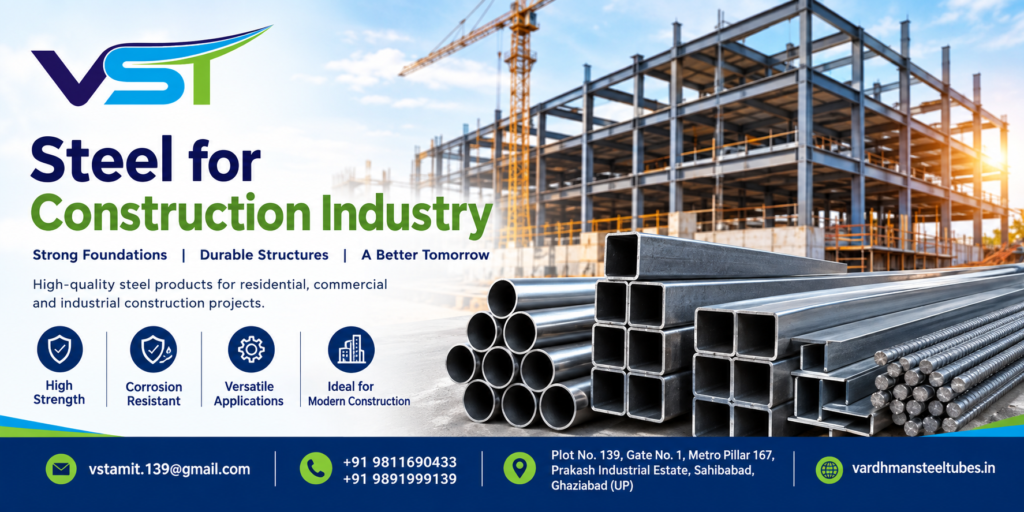
Steel remains one of the most relied-upon materials in construction because it offers a practical balance of strength, workability, and consistency. Whether it’s a structural framework, a fabricated railing, or an industrial support system, Steel for Construction Industry use gives builders and fabricators a material that performs predictably under load, welds cleanly, and holds its shape over time. Choosing the right steel tubes and pipes — with the correct grade, dimensions, and finish — directly affects fabrication efficiency, structural reliability, and how long a project performs before maintenance is needed.
Quick Answer
Steel is used in construction for structural frameworks, railings, gates, equipment supports, and fabricated components because it offers high strength, dimensional consistency, and fabrication flexibility. Steel tubes and pipes can be cut, welded, and formed into different profiles, making them suitable for both load-bearing structures and lighter architectural or industrial fabrication work.
What is Steel Used for in the Construction Industry?
Steel plays two broad roles in construction: structural and fabricational.
In structural applications, steel sections and tubes are used for building frameworks, load-bearing supports, and construction machinery bases where strength and stability under load are the primary requirement. In fabrication applications, steel tubes are used for railings, gates, grills, partitions, and equipment structures where the focus is on precise dimensions, clean welds, and a good surface finish rather than heavy load-bearing capacity.
Understanding this distinction matters because not every steel product is designed for the same purpose. A tube well suited for a decorative railing may not be the right choice for a load-bearing column, and vice versa. Matching the product to the application is the first step in any steel-buying decision.
Top Benefits of Steel for Construction Industry Applications
Strength and Structural Performance
Steel is widely selected wherever strength-to-weight performance matters. It can carry substantial loads relative to its cross-sectional size, which is why it is common in frameworks, supports, and structures that need to resist bending, compression, or dynamic loads over time.
Durability
Steel’s service life depends heavily on correct grade selection, proper fabrication practices, appropriate surface finishing, and routine maintenance. A well-selected and well-finished steel product can perform reliably for years, while an unsuitable grade or poor finishing choice in a harsh environment can shorten service life considerably.
Fabrication Flexibility
One of steel’s biggest practical advantages is how easily it can be cut, welded, drilled, bent, and assembled. This flexibility allows fabricators to adapt standard tube stock to a wide range of project-specific designs without needing entirely custom raw material.
Dimensional Consistency
Consistent outer dimensions and wall thickness are essential when components need to fit together accurately — for example, in modular frameworks or assemblies with multiple joints. Inconsistent tubing can cause alignment issues, uneven welds, and rework during fabrication.
Efficient Material Usage
Hollow steel tubes can offer efficient material usage for certain applications, since they provide useful strength while using less material than an equivalent solid section. This is not a universal rule — solid sections remain the better choice for some structural requirements — but where appropriate, tubes can reduce weight and material cost without compromising the intended function.
Design Versatility
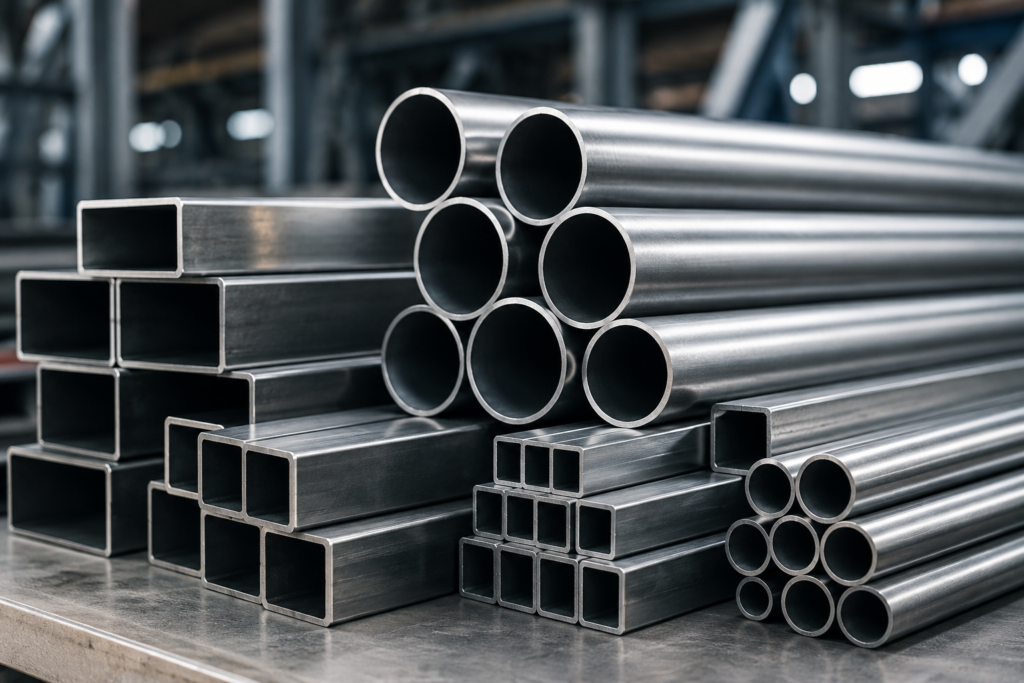
Round, square, and rectangular steel tube profiles each suit different design and structural needs. Round tubes are common in railings and frames, square tubes are often used in structural framing and fabrication, and rectangular tubes are useful where flat mounting surfaces or specific load orientations are needed.
Steel Tubes and Pipes Used in Construction
| Steel Product | Typical Characteristics | Example Applications |
| Round Steel Tubes | Uniform strength in all directions, easy to weld and bend | Railings, frames, supports |
| Square Steel Tubes | Flat surfaces for mounting and joining, good torsional strength | Frames, structures, fabrication |
| Rectangular Tubes | Directional strength, flat top and bottom surfaces | Frameworks and equipment |
| CRC Tubes/Pipes | Smooth finish, close dimensional tolerance | Precision fabrication and suitable construction-related applications |
Role of CRC Steel Products in Construction & Fabrication
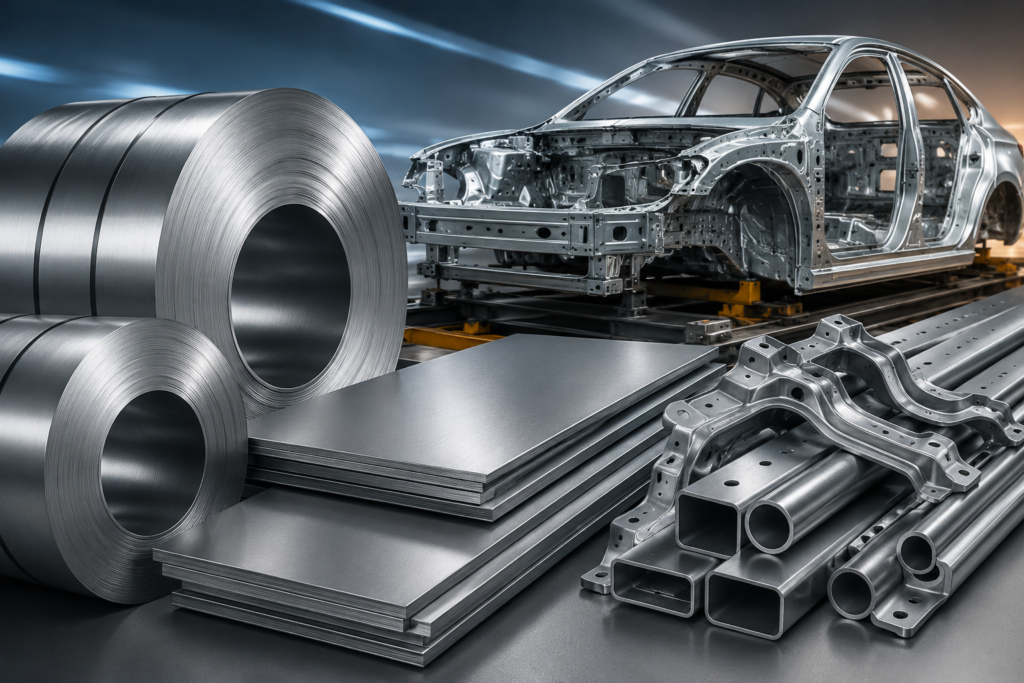
Cold Rolled Coil (CRC) steel is processed at room temperature after initial hot rolling, which gives it a smoother, brighter surface finish and tighter dimensional accuracy compared to hot-rolled products. CRC pipes and tubes are known for their consistent wall thickness, close tolerances, and clean appearance, which makes them well suited for applications where fit and finish matter.
As a CRC steel products supplier, Vardhman Steel Tubes notes that its CRC pipes and tubes are used across several fabrication categories, including furniture manufacturing, e-rickshaw manufacturing, gym equipment, automotive parts, and other fabricated products. These are largely appearance- and precision-driven applications rather than heavy structural, load-bearing construction uses. In construction-related work, CRC tubes are more commonly found in interior fabrication, railings, and equipment structures where a smooth finish and accurate dimensions are priorities, rather than in primary structural framing.
Applications of Steel in Construction
Building Frameworks
Structural steel sections and fabricated components are used to form building frameworks, providing the skeleton that supports floors, roofs, and walls in many construction types.
Railings and Safety Structures
Steel tubes are widely used for stair railings, balcony guards, and safety barriers, where consistent dimensions and clean welds contribute to both appearance and safety.
Gates and Grills
Steel tubes are a practical choice for fabricated gates and grills because they can be cut and welded into custom patterns while offering enough rigidity for daily use.
Interior and Architectural Fabrication
Furniture frames, partitions, display structures, and decorative elements often rely on steel tubes for their combination of strength, workability, and finish.
Industrial Construction
In industrial settings, steel tubes and sections support equipment platforms, machinery frames, and other fabricated structures where load-bearing capacity and dimensional accuracy both matter.
How to Choose the Right Steel for a Construction Project
- Application – defines whether structural strength or fabrication precision matters more.
- Required dimensions – affects fit, assembly, and design compatibility.
- Wall thickness – influences strength, weight, and cost.
- Steel grade – determines mechanical properties suited to the load.
- Load requirements – dictates minimum strength and section size.
- Surface finish – matters for appearance and further processing like painting or coating.
- Fabrication method – welding, bending, or machining needs vary by product.
- Welding requirements – some grades and finishes weld more predictably than others.
- Corrosion/environmental conditions – determines the need for coatings or corrosion-resistant grades.
- Quantity – affects pricing, lead time, and supplier selection.
- Applicable standards – ensures the product meets project or regulatory requirements.
- Quality documentation – confirms material traceability and compliance.
- Delivery requirements – affects project scheduling and site logistics.
Each of these factors interacts with the others, so it’s worth reviewing them together rather than focusing on price or dimensions alone.
Steel Tubes for Fabrication: What Buyers Should Know
Fabricators should evaluate several practical factors before ordering steel tubes, including cutting requirements, the intended welding method, dimensional tolerance, straightness, surface condition, finishing needs, and expected production volume. A tube that is slightly out of tolerance or has an uneven surface can slow down production and affect the quality of finished joints.
For example, a manufacturer producing steel furniture frames typically needs tubes with a consistent outer diameter and smooth surface finish so that welded joints look clean and require minimal grinding or rework. Getting these specifications right before ordering reduces waste and keeps production timelines predictable.
How to Choose a Reliable Steel Supplier
Selecting a steel supplier based on price alone often leads to inconsistent quality or delivery issues. Instead, buyers should evaluate product consistency, clarity in specifications, quality checks, stock availability, delivery reliability, product range, technical understanding, communication, documentation, and the supplier’s ability to meet specific project requirements.
Vardhman Steel Tubes, based in Ghaziabad, is one such industrial steel supplier in India, operating as a wholesale and trading business supplying CRC pipes, tubes, sheets, and related steel products for various industrial and fabrication requirements. As a CRC steel supplier in Delhi NCR, working with a supplier that understands both the product and its intended application can make ordering and fabrication smoother for buyers across the region.
Common Mistakes When Buying Construction Steel
- Choosing a supplier or product only on price
- Ignoring wall thickness in favor of outer dimensions alone
- Not clearly defining the intended application before ordering
- Ordering incorrect dimensions due to unclear specifications
- Ignoring surface finish requirements
- Not confirming quantity and delivery timelines in advance
- Failing to check relevant quality documentation
- Using a product outside its intended application, such as a fabrication-grade tube for structural load-bearing use
Practical Buying Example
A fabricator needs steel tubes for railing and frame production. To choose correctly, they should work through the requirement step by step: first confirm the application (railings and frames, not heavy structural columns), then select the profile (round tubes for railings, square tubes for frame corners), followed by the dimensions and wall thickness needed for the expected load and appearance. Next, they should confirm the required surface finish for a clean, weldable product, estimate the quantity needed for the project, choose a supplier who can consistently meet these specifications, and finally confirm delivery timing to match the fabrication schedule. Following this sequence helps avoid mismatched orders and production delays.
Quick Comparison: What Matters Most?
| Requirement | What to Check |
| Strength | Grade and section dimensions |
| Fabrication | Weldability and form |
| Appearance | Surface finish |
| Accuracy | Dimensions and tolerances |
| Durability | Material and protective finish |
| Procurement | Availability and delivery |
FAQs
1. Why is steel important for the construction industry?
Steel is important because it offers a reliable combination of strength, workability, and dimensional consistency. It can be fabricated into structural frameworks, railings, gates, and equipment supports, making it suitable for both load-bearing and non-structural construction applications where predictable performance is required.
2. What types of steel tubes are used in construction?
Common types include round, square, and rectangular steel tubes, along with CRC (cold rolled) tubes and pipes. Round tubes are often used for railings, square and rectangular tubes for frames and structures, and CRC tubes for applications needing a smooth finish and precise dimensions.
3. Are steel tubes suitable for fabrication?
Yes, steel tubes are well suited for fabrication because they can be cut, welded, drilled, and bent into different shapes. Their consistent dimensions make it easier for fabricators to produce accurate, repeatable components for railings, frames, furniture, and equipment structures.
4. What should I check before buying construction steel?
Buyers should confirm the application, required dimensions, wall thickness, steel grade, load requirements, surface finish, fabrication method, and applicable standards. Checking quality documentation and confirming delivery timelines also helps avoid mismatched orders and project delays.
5. How do I choose a reliable steel supplier in India?
Look for a supplier who offers consistent product quality, clear specifications, proper quality checks, adequate stock availability, and reliable delivery. Technical understanding and clear communication about your specific application are equally important, not just competitive pricing.
Conclusion
Steel continues to be a practical, dependable choice across construction and fabrication because it adapts to a wide range of structural and design requirements. The right steel product for any given project depends on its application, required dimensions, structural demands, fabrication process, surface finish, and the environmental conditions it will face. Taking time to match these factors to the correct steel tube or pipe — round, square, rectangular, or CRC — helps ensure better fabrication outcomes and longer-term performance.
If you’re sourcing steel tubes, pipes, or CRC products for an upcoming construction or fabrication project, reach out to Vardhman Steel Tubes to discuss your specifications and get the right product for your requirements.
Call: +91-9811690433, +91-9891999139
Email: vstamit.139@gmail.com
Address: Plot No. 139, Gate No. 1, Metro Pillar 167, Prakash Industrial Estate, Sahibabad, Ghaziabad (UP)