Picture this: you’re standing at a hardware store counter, or maybe on a job site, and someone hands you a quote with two line items — “CRC pipe” and “ERW pipe.” You nod along, but inside you’re wondering, what’s actually the difference, and does it even matter for my project?
You’re not alone. This is one of the most common questions we hear at Vardhman Steel Tubes, whether it’s from a first-time home builder, a contractor sourcing material for a factory shed, or a fabricator trying to keep costs in check without compromising on quality. Steel pipes might look similar on the surface, but the manufacturing process behind them can make a real difference in strength, finish, cost, and how long they’ll last in your specific application.
In this guide, we’ll break down CRC pipes and ERW pipes in plain language — no confusing jargon, just practical information you can actually use to make the right call for your next project.
What Are CRC Pipes and ERW Pipes, Really?
Let’s start from the basics, because understanding the “why” behind these pipes makes the buying decision a lot easier.
CRC Pipes: Cold Rolled, Closely Controlled
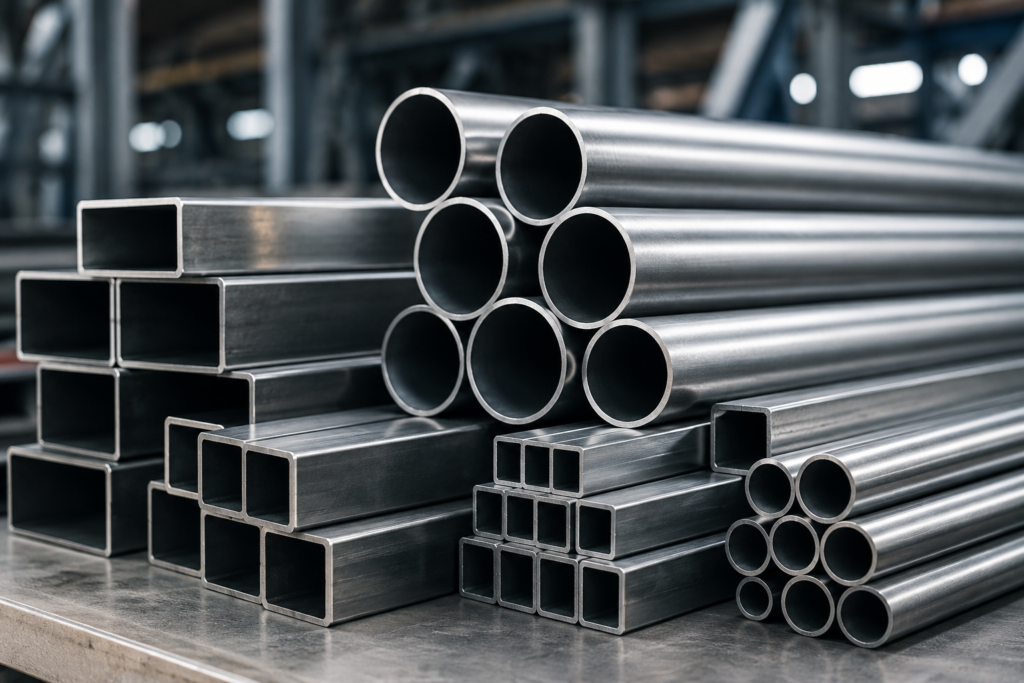
CRC stands for Cold Rolled Coil. These pipes are made from steel coils that have been rolled at room temperature (rather than being heated up), which gives the final product a smoother surface, tighter dimensional tolerance, and better mechanical strength. Think of CRC as the more “refined” cousin in the steel pipe family — it goes through an extra layer of processing that makes it more precise and consistent.
Because of this cold-rolling process, CRC pipes tend to have a cleaner, shinier finish and are often preferred where appearance and precision both matter — think furniture frames, display racks, or components that need a polished look.
ERW Pipes: Strong, Reliable, and Widely Used
ERW stands for Electric Resistance Welded. These pipes are formed by rolling a steel strip into a cylindrical shape and then welding the seam using electric resistance heat. It’s a fast, efficient, and time-tested method that’s been used across industries for decades — from plumbing and fencing to structural framing and irrigation.
ERW pipes are the workhorse of the steel pipe world. They’re not trying to be flashy — they’re built to be dependable, cost-effective, and available in a huge range of sizes and thicknesses.
CRC Pipes vs. ERW Pipes: Side-by-Side Comparison
Here’s where things get practical. Let’s put both pipe types head-to-head so you can see exactly where each one stands out.
Comparison Table: CRC Pipes vs. ERW Pipes
| Parameter | CRC Pipes | ERW Pipes |
| Manufacturing Process | Cold rolling of steel coils at room temperature | Strip rolled into shape, seam welded electrically |
| Surface Finish | Smooth, clean, slightly glossy | Functional, less refined finish |
| Dimensional Accuracy | Very high, tight tolerances | Good, but slightly less precise |
| Strength | High tensile strength | Strong, well-suited for structural use |
| Cost | Slightly higher due to extra processing | More budget-friendly |
| Common Uses | Furniture, racks, precision frames, appliances | Plumbing, fencing, structural framing, irrigation |
Note: Actual performance can vary slightly depending on the grade of steel, wall thickness, and coating applied. Always check technical specs before finalizing.
Key Benefits of CRC Pipes
If you’re leaning towards CRC pipes, here’s what you’re getting:
- Superior surface finish — ideal for products where appearance matters as much as function
- Tighter tolerances — better for precision-fit applications
- Better weldability and paint adhesion — smoother surface holds coatings more evenly
- Higher strength-to-weight ratio — useful in lightweight structural components
- Consistent quality — cold rolling reduces surface defects common in hot-rolled material
Key Benefits of ERW Pipes
ERW pipes have earned their reputation for good reason:
- Cost-effective — great value without compromising on core strength
- Widely available — easy to source in bulk, in various sizes
- Versatile — works well for plumbing, structural, and general fabrication needs
- Faster production — the welding process allows for efficient, large-scale manufacturing
- Proven track record — decades of use across construction and infrastructure projects
How to Choose the Right Pipe for Your Project
Rather than guessing, walk through this simple decision process:
Step-by-Step Selection Guide
| Step | What to Do | Why It Matters |
| 1. Define the application | Is it structural, decorative, or functional? | Determines whether strength or finish takes priority |
| 2. Check load requirements | Calculate or ask for expected load-bearing needs | Both types perform well, but wall thickness matters more here |
| 3. Consider the finish | Will the pipe be visible or painted? | CRC gives a cleaner base for visible or premium finishes |
| 4. Set your budget | Compare project scale vs. cost per pipe | ERW often wins for large-volume, budget-conscious projects |
| 5. Talk to a trusted supplier | Get technical guidance based on your exact specs | A good CRC pipes dealer in India can save you from costly mismatches |
This step-by-step approach helps narrow down the right pipe type before you even request a quote.
Tips and Best Practices When Buying Steel Pipes
- Always ask for the mill test certificate (MTC) — it confirms the chemical and mechanical properties of the steel
- Match the wall thickness to your load requirement — don’t just go by outer diameter
- Buy from a reliable, established supplier — consistency in quality matters more than a one-time low price
- Check for ISI or BIS certification where applicable, especially for structural use
- Ask about coating options — galvanized or painted finishes can extend the life of the pipe significantly
- Don’t ignore storage and handling — poor storage can cause rusting or surface damage even before installation
Quick Reference: Do’s and Don’ts
| Do | Don’t |
| Match pipe type to your specific application | Choose based on price alone |
| Verify certifications and test reports | Assume all pipes of the same size perform equally |
| Ask your supplier technical questions upfront | Skip the specification sheet |
| Store pipes in dry, covered conditions | Leave pipes exposed to moisture for long periods |
A quick checklist to keep handy before you finalize your next steel pipe order.
Common Mistakes to Avoid
Even experienced buyers slip up sometimes. Here are a few mistakes we see often:
- Choosing purely on price: The cheapest pipe isn’t always the most economical in the long run — factor in durability and maintenance.
- Ignoring the end-use environment: A pipe exposed to moisture or chemicals needs different protection than one used indoors.
- Overlooking wall thickness: Two pipes of the same diameter can behave very differently under load if their thickness varies.
- Not asking about certifications: Skipping this step can lead to compliance issues later, especially in structural or government projects.
- Buying from unverified sellers: Working with an established supplier reduces the risk of inconsistent quality or short weight.
Buying Guide Checklist
| Checklist Item | Why You Need It |
| Correct grade of steel | Ensures suitability for your load and environment |
| Accurate wall thickness | Affects strength, weight, and cost |
| Verified supplier reputation | Reduces risk of inconsistent batches |
| Proper documentation | Needed for compliance and future reference |
| Delivery and handling terms | Prevents damage during transit and storage |
Use this checklist as a final review before placing your order with any supplier.
Why Work With a Trusted CRC Pipes Dealer in India?
Here’s the thing — even the best pipe on paper won’t help you if it’s poorly manufactured, inconsistently sized, or delivered late. This is where working with an experienced and reliable CRC pipes dealer in India makes a real difference.
At Vardhman Steel Tubes, we’ve spent years supplying both CRC and ERW pipes to builders, fabricators, and industries across the country. We understand that no two projects are exactly alike, which is why we focus on helping customers pick the right product rather than just pushing whatever’s in stock. Quality checks, proper documentation, and honest guidance are non-negotiables for us — because your project’s success is genuinely our reputation too.
Frequently Asked Questions
1. Are CRC pipes stronger than ERW pipes?
CRC pipes generally offer higher tensile strength and better dimensional accuracy due to the cold rolling process, but ERW pipes are also strong and well-suited for most structural and general-purpose needs.
2. Which is more cost-effective, CRC or ERW pipes?
ERW pipes are usually more budget-friendly because of their simpler manufacturing process, making them a popular choice for large-scale or cost-sensitive projects.
3. Can CRC pipes be used for structural applications?
Yes, CRC pipes can be used structurally, especially where precision and a smooth finish are also required, such as in frames and support structures for machinery or furniture.
4. Do ERW pipes rust faster than CRC pipes?
Not necessarily. Corrosion resistance depends more on the coating (galvanized, painted, etc.) and storage conditions than on whether the pipe is CRC or ERW.
5. How do I find a reliable CRC pipes dealer in India?
Look for a supplier with proper certifications, transparent pricing, consistent stock quality, and a track record of serving similar projects — a quick conversation about your requirements can also reveal a lot about their expertise.
6. Can I mix CRC and ERW pipes in the same project?
Absolutely. Many projects use CRC pipes for visible or precision components and ERW pipes for structural or hidden framework, optimizing both cost and finish.
Final Thoughts
At the end of the day, there’s no universal “better” pipe — it all comes down to what your project actually needs. If appearance, precision, and a smooth finish are priorities, CRC pipes are likely your best bet. If you’re working on a larger structural project where cost-efficiency and proven durability matter most, ERW pipes will serve you well.
The smartest move isn’t picking a side before understanding your application — it’s talking to people who deal with these materials every single day. That’s exactly where Vardhman Steel Tubes come in. Whether you need CRC pipes, ERW pipes, or guidance on which one fits your project best, our team is happy to walk you through the specifics and help you make a confident, well-informed decision.
Have a project coming up? Reach out to Vardhman Steel Tubes for expert guidance, transparent pricing, and reliable supply of both CRC and ERW pipes — tailored to what your project actually needs.
Visit: https://vardhmansteeltubes.in/
Call: +91-9811690433, +91-9891999139
Email: vstamit.139@gmail.com
Address: Plot No. 139, Gate No. 1, Metro Pillar 167, Prakash Industrial Estate, Sahibabad, Ghaziabad (UP)